Automatic Gate Repairs in Sydney
Most automatic gate faults show up as one of a handful of symptoms. The symptom points to a few likely causes, and a proper diagnosis on site is what separates a quick fix from replacing parts that were never broken.
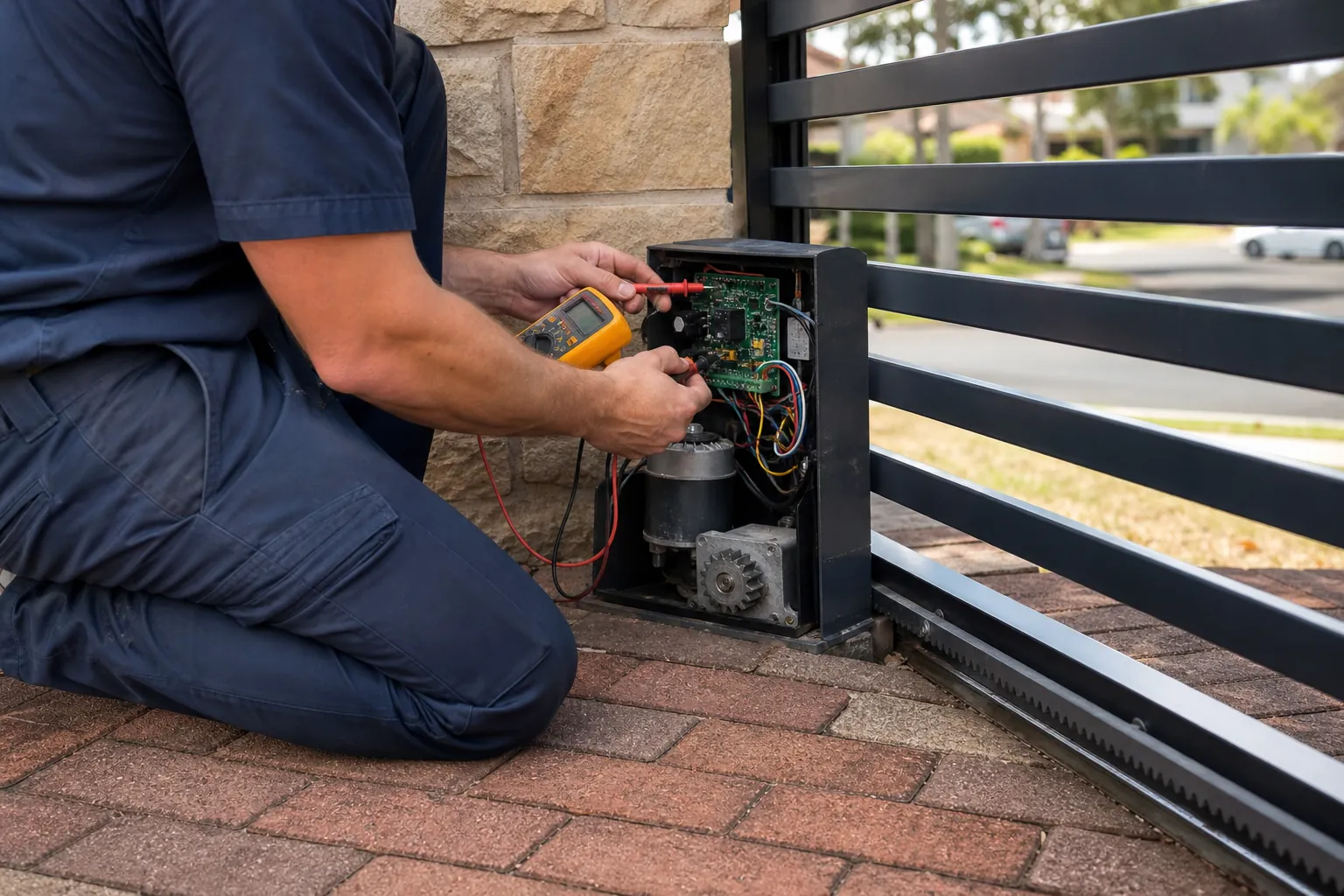
Start with the symptom, not the part
An automatic gate is a simple system once you break it down: a gate that has to move freely, a motor and gearbox that push it, a control board that decides when and how hard to push, a power supply (mains, battery or solar), and safety devices that tell the board to stop. When the gate misbehaves, the symptom usually tells a technician which of those five areas to look at first.
| Symptom | Common places to look |
|---|---|
| Gate opens part way then stops | Friction in the track or hinges, low battery, limit settings, obstruction sensing |
| Gate closes then reverses back open | Safety beams, force sensitivity, a tight spot along the travel |
| Control box beeps or flashes | Fault or battery codes, which vary by brand |
| Remote does nothing | Remote battery, receiver memory, interference, the board itself |
| Gate drifts open or closed by itself | Manual release left disengaged, worn gearbox, sagging hinges or a slope |
| Motor hums but the gate does not move | Stripped gears, a seized gate, a failed capacitor on some models |
Why the gate is usually the first suspect
A large share of so-called motor faults are really gate faults. Gate controllers measure how hard the motor is working. When a roller seizes, a track fills with grit or a hinge wears and the leaf drops, the motor has to push harder, and the board reads that extra load as an obstruction. It stops or reverses to protect people, which is exactly what it is designed to do.
That is why a good diagnosis often begins with the motor disengaged. With the manual release open, the technician pushes the gate through its full travel by hand. A gate that runs smoothly with light effort points the investigation back to the electronics. A gate that binds, drags or swings back on its own tells you the motor is being asked to do something it should never have to.
Power faults are common and easy to miss
Many residential gate systems run on a low-voltage battery that is charged from mains power or a solar panel. The battery lets the gate keep working through a blackout, but it also ages. A tired battery may run the gate fine first thing in the morning and then fail by the third cycle of the day, which looks like an intermittent fault.
Solar systems add their own variables: a panel shaded by a tree that has grown since installation, a dirty panel, or a charge controller that has failed. Mains systems can lose supply at a tripped circuit or a damaged cable. Anything on the 230 volt side is electrical work, and in NSW electrical wiring work has to be done by a licensed electrician. Many gate technicians hold that licence; if yours does not, they should bring in someone who does.
What happens when you send an enquiry
You tell us the gate type, the brand if you know it, and what it is doing. We pass the job to an independent local technician in your part of Sydney. They contact you, arrange a visit, diagnose the fault and give you a price for the repair before doing the work. The technician quotes and works under their own business, licences and insurance.
If the motor turns out to be past economical repair, they can talk you through gate motor replacement. If the fault is in the gate hardware itself, see sliding gate track and roller repairs or swing gate hinge and arm repairs.
Before the technician arrives
- Note exactly what the gate does and when: every cycle, only in the afternoon, only after rain
- Write down any beep pattern or flashing light sequence on the control board
- Find the motor brand and model, usually on a sticker inside the cover
- If the gate is stuck open or closed, use the manual release rather than forcing it, as covered in our manual release guide
That information alone can shorten a diagnosis and help the technician bring the right parts on the first visit.
Why choose us for automatic gate repairs
- Fault diagnosed on site before any repair is priced
- Gate hardware checked with the motor disengaged, not just the electronics
- Local technicians across Sydney, from the beaches to the west
- Mains-side electrical work handled by a licensed electrician
- Works with common brands such as BFT, Centurion, ATA, Nice and FAAC
Automatic Gate Repairs: common questions
My gate stopped working overnight. Is it the motor?
Not necessarily. A dead battery, a tripped circuit, a failed remote or a seized roller can all make a gate look completely dead. A technician will usually check power and free movement of the gate before condemning the motor.
Can a technician repair a gate brand they did not install?
Usually, yes. Independent gate technicians commonly work across the popular brands, including BFT, Centurion, ATA, Merlin, DACE, Nice and FAAC. Parts availability for older or discontinued models is the main limit, and they will tell you if that is a problem.
Is it safe to keep using a gate that keeps reversing?
It is better not to. A gate that reverses is often reacting to a real problem, such as a misaligned safety beam or a gate that has started to bind. Repeated attempts can overheat the motor or wear the gearbox. Leave it open or closed using the manual release and get it looked at.
Gate playing up?
Tell us what your gate is doing and we will connect you with a local technician who can diagnose it and quote the repair.